Clarity Act Failure Pushes Crypto Toward Federal Oversight
Executive Market Summary
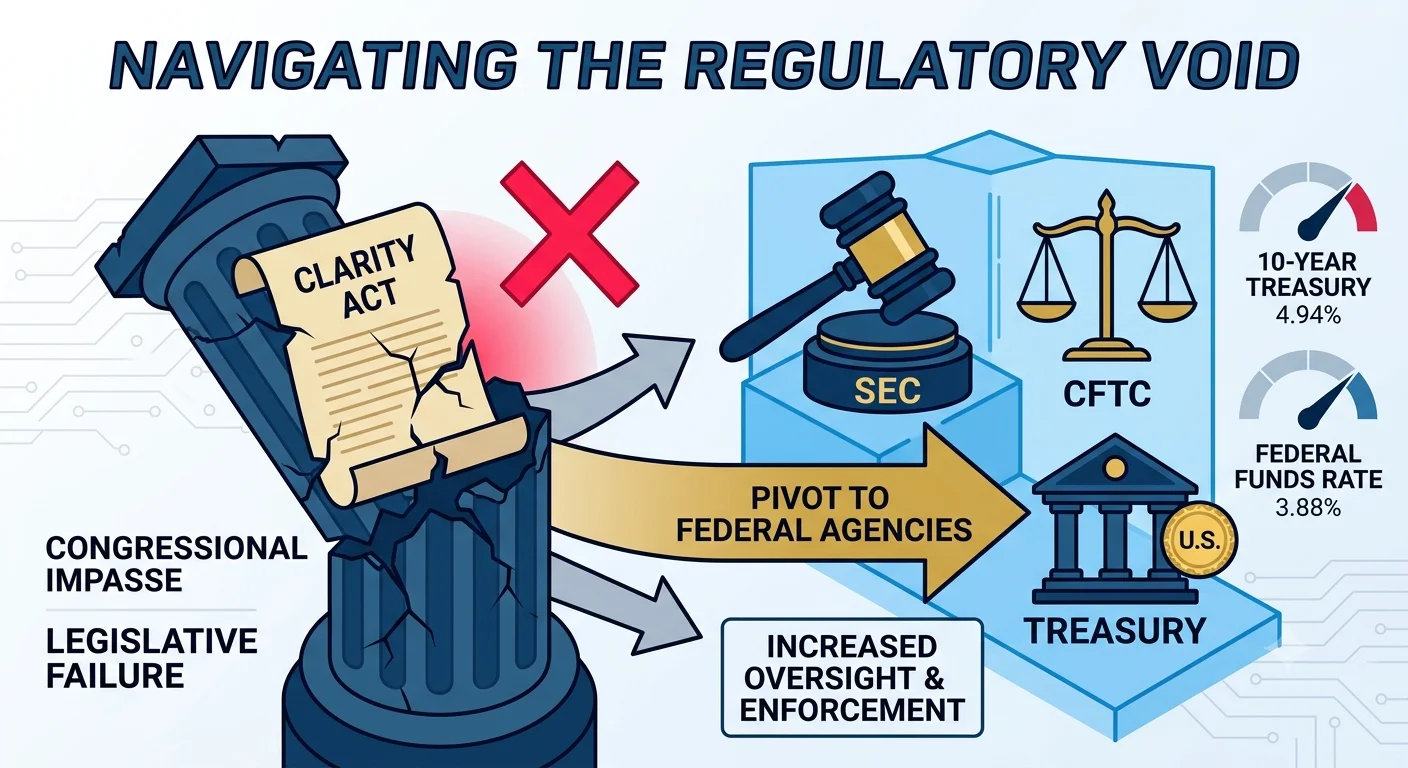
The collapse of the Clarity Act has left the cryptocurrency industry searching for regulatory clarity through federal channels, even as macroeconomic...
Legislative Impasse Redirects Industry Strategy
The procedural failure of the **Digital Asset Market Clarity Act** in the U.S. Senate has created a critical policy vacuum across the cryptocurrency sector. Falling short of the 60-vote threshold required to proceed to a floor vote (49–50), the legislation stalled under intense partisan friction and lobbying pushback. The bill—which was designed to establish a statutory boundary between SEC investment contract oversight and CFTC digital commodity spot authority—leaves the industry without the legal architecture it spent years advocating for.
According to reporting from the *Wall Street Journal*, the legislative standstill has accelerated a tactical pivot in compliance and lobbying. Major digital asset exchanges, custodians, and token issuers are abandoning hopes for swift statutory relief, instead reallocating capital toward direct engagement with the Securities and Exchange Commission (SEC), the Commodity Futures Trading Commission (CFTC), and the Treasury Department to secure administrative and interpretive guidance under existing statutes.
Key Legislative Sticking Points
The breakdown of the Clarity Act was driven by several core jurisdictional and structural disputes:
- **SEC vs. CFTC Jurisdictional Divide:** Lawmakers struggled to reach consensus on the "mature blockchain" test—the legal threshold under which an asset transitions from an investment contract (SEC purview) to an open, decentralized digital commodity (CFTC purview).
- **Traditional Banking Conflicts on Stablecoins:** Traditional banking trade associations mounted fierce opposition to clauses permitting certain yield-bearing stablecoins to compete directly with commercial bank deposits without equivalent reserve and depository obligations.
- **Executive & Public Official Holdings:** Bipartisan disputes over mandatory divestment rules and blind-trust requirements for political figures holding digital asset interests further complicated the final negotiations.
Macroeconomic Backdrop Complicates the Transition
The timing of this regulatory setback comes at an unforgiving juncture for risk assets. With the **10-Year Treasury Rate standing at 4.94%** and the **Federal Funds Rate at 3.88%** as of mid-September, capital markets are pricing in elevated baseline risk premiums. For crypto firms navigating ambiguous compliance mandates, the cost of capital to maintain legal defense funds, redesign infrastructure, and secure institutional banking channels is higher than during previous regulatory cycles.
Tighter domestic liquidity conditions and elevated borrowing rates mean that administrative delays carry immediate structural consequences. Startups and venture-backed protocols that delayed token generation events (TGEs) or secondary capital raises pending statutory clarity now face compressed valuations and an unforgiving funding environment.
Federal Agencies Step Into the Void
In the absence of clear congressional mandates, federal agencies are stepping into the void using existing discretionary authority:
- **The SEC** continues to utilize targeted enforcement actions, applying the *Howey* test to classify unregistered token distributions and algorithmic protocols as securities offerings.
- **The CFTC** is expanding its footprint across digital commodity derivatives, asserting authority over decentralized platforms offering leveraged products to U.S. retail participants.
- **The Treasury (FinCEN & OFAC)** remains focused on expanding Bank Secrecy Act obligations to decentralized finance front-ends and cross-chain messaging bridges.
This agency-driven dynamic has been reflected in market behavior. As explored in our related market briefing, [Bitcoin, Ethereum Rise Past CLARITY Act Legislative Setback](/article/061395af-a9a0-4795-a647-509bf7156c4b), large-cap digital assets like BTC and ETH—which already have clearer jurisdictional precedents—continue to show relative resilience, while crypto equities and early-stage token issuers absorb the brunt of the compliance shock.
What Comes Next
The industry's retreat toward agency-level engagement represents a structural change in U.S. crypto operations. Rather than operating under a single, codified federal standard, firms must now navigate a mosaic of:
- Informal agency staff guidance and "no-action" letters.
- Formal administrative rulemaking petitions and public comment periods.
- Court-mandated interpretations arising from ongoing enforcement litigation.
While this fragmented regime offers incremental avenues for compliance, it inherently elevates regulatory litigation risk and operational friction. Until Congress returns to comprehensive market-structure legislation, U.S. digital asset enterprises will remain bound to an agency-by-agency framework defined by shifting administrative priorities and ongoing legal challenges.
---
*Disclaimer: This analysis is for informational and educational purposes only and does not constitute financial, legal, or investment advice. Market data and yields verified as of September 19, 2026. Always conduct your own research (DYOR) before committing capital to digital assets.*