Intel and Lens Technology Collaborate to Advance Semiconductor Packaging for AI Era
Executive Market Summary
Intel and Lens Technology signed a strategic MOU to advance Through Glass Via (TGV) glass substrate packaging, aiming to boost interconnect density...
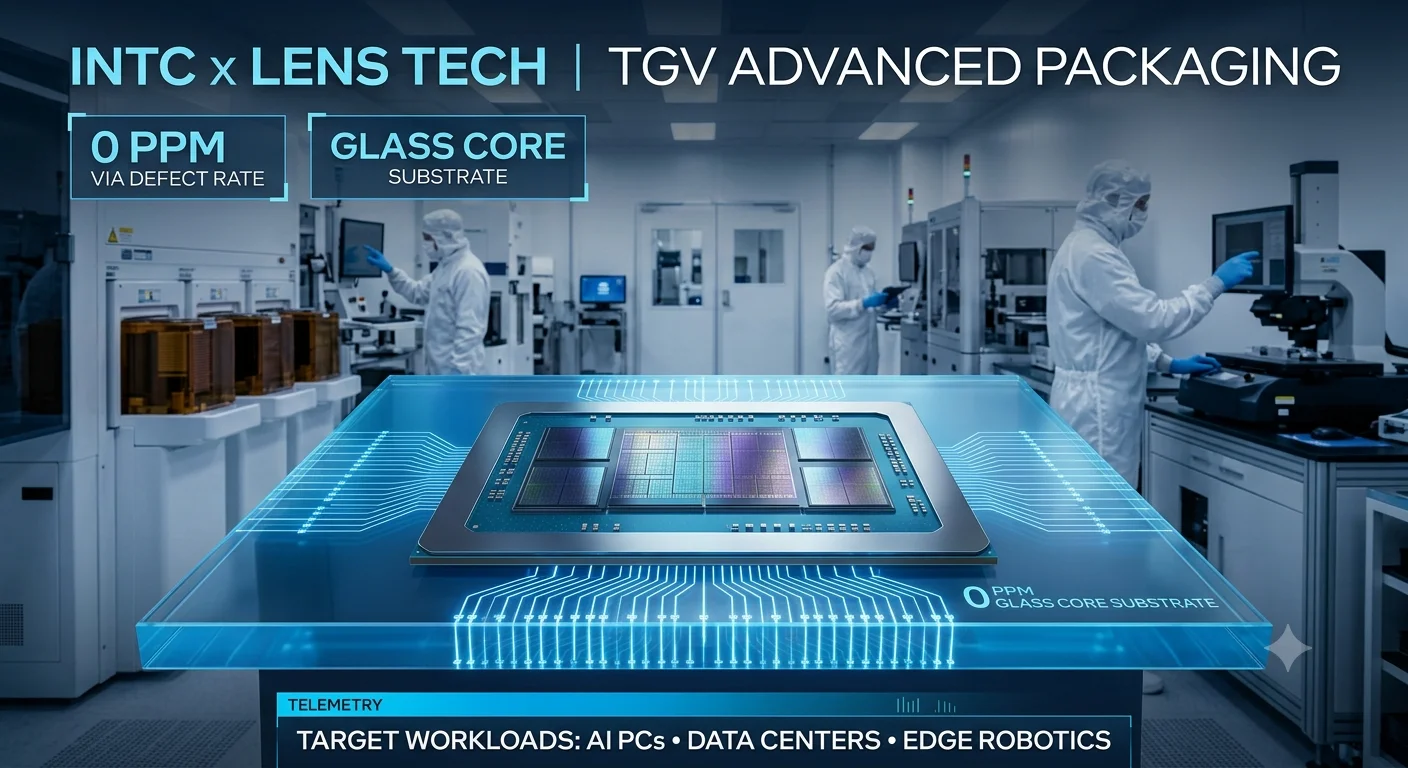
Intel Corporation (NASDAQ: INTC) has finalized a strategic Memorandum of Understanding (MOU) with Lens Technology to accelerate the commercialization of advanced semiconductor packaging for the artificial intelligence era [Source: Intel Press Room, Simply Wall St]. Officially confirmed on July 24, 2026, the non-binding agreement centers around **Through Glass Via (TGV)** glass substrate packaging—a next-generation architecture engineered to solve structural thermal limits and interconnect bottlenecks in high-performance computing (HPC) [Source: Intel Press Room, PANews].
Transitioning from Organic Substrates to TGV Glass Solutions
As multi-chiplet processing and intensive AI workloads push traditional organic substrate materials to their physical limits, glass substrates are emerging as the industry standard for high-density silicon integration [Source: BigGo Finance]. Glass offers exceptional electrical insulation, planarity, and thermal stability, allowing chip designers to etch tighter via pitches with minimal signal degradation [Source: BigGo Finance].
Under the terms of the memorandum signed via Lens International (Hong Kong), the joint efforts will focus on core manufacturing processes required for full-scale TGV deployment [Source: PANews]:
- **Precision Hole Formation:** Refining laser-induced etching and chemical etching pipelines to maximize via throughput [Source: PANews, BigGo Finance].
- **Metallized Via Deposition:** Establishing uniform conductive channels across multi-layer interconnect wiring [Source: PANews].
- **Design for Manufacturability (DFM):** Intel will provide architecture specs, benchmark testing protocols, and DFM guidelines to streamline sample verification [Source: PANews].
| Packaging Dimension | Traditional Organic Substrate | TGV Glass Substrate Solution |
|---|---|---|
| **Material Foundation** | Polymer / Epoxy Composite | Precision Processed Glass Core |
| **Interconnect Density** | Limited by thermal expansion limits [Source: BigGo Finance]. | High-density Via formation with minimal distortion [Source: Intel Press Room, BigGo Finance]. |
| **Defect Rate Standards** | Standard industry yield tolerances | 0 PPM through-hole target demonstrated by Lens Tech [Source: BigGo Finance]. |
| **Hardware Applications** | Legacy client and server CPUs | AI PCs, HPC Data Centers, & Edge Robotics [Source: Simply Wall St]. |
Industrial Readiness and Technical Benchmarks
Lens Technology brings established precision manufacturing capabilities to the partnership [Source: Intel Press Room]. At the 2026 World Artificial Intelligence Conference (WAIC), Lens showcased a self-developed TGV glass core substrate utilizing a composite laser-induced and chemical etching process that achieved a **0 ppm (zero parts per million)** through-hole defect rate [Source: BigGo Finance].
Intel CEO Lip-Bu Tan underscored the strategic necessity of scaling alternative packaging mediums:
"Advanced packaging is becoming a critical driver of semiconductor innovation as AI systems continue to push the boundaries of performance, scale, and efficiency. Intel brings deep expertise in architecture and advanced packaging, while Lens Technology possesses world-class competitiveness in precision glass processing and laser manufacturing." [Source: Intel Press Room, BigGo Finance]
Market Outlook and Institutional Context
While the MOU represents an early-stage, non-binding framework, it highlights how major foundries are positioning their assembly supply chains ahead of mass commercialization [Source: Simply Wall St]. For Intel, securing reliable glass processing partners complements its broader chiplet strategy—including EMIB and Foveros architectures—as the company targets higher transistor counts per package by the end of the decade [Source: Intel Foundry].
With capital expenditures across the AI hardware sector remaining elevated, cross-border manufacturing agreements that optimize packaging yield metrics will remain essential for sustaining hardware performance gains [Source: Simply Wall St, BigGo Finance].
**Disclaimer**: This article is for informational purposes only and does not constitute financial advice. Always conduct your own research (DYOR) before making investment decisions. Market data and prices are subject to change. Sources verified as of July 24, 2026.