The EU-Canada Associate Pact: Strategic Hedge or Illusion?
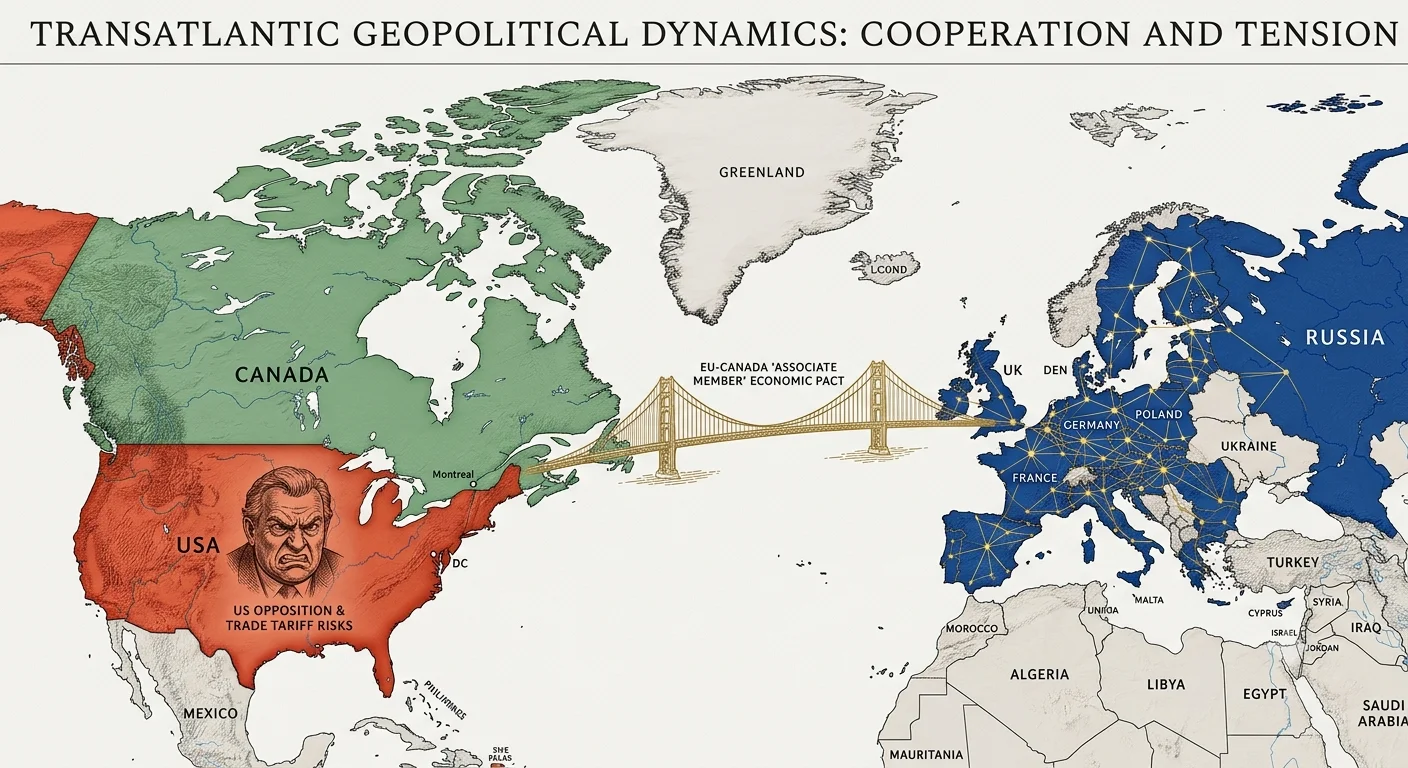
Executive Market Summary
Ursula von der Leyen and Mark Carney's push for Canada to become the EU's first 'associate member' isn't about flags or passports. It is a high-stakes...
Beyond the Standing Ovation in Strasbourg
When European Commission President Ursula von der Leyen proposed opening the door for Canada as the European Union’s first-ever **"associate member"**—prompting a standing ovation alongside Canadian Prime Minister Mark Carney in Strasbourg—mainstream headlines framed the moment as a historic constitutional pivot.
It is not.
Neither Ottawa nor Brussels is rewriting Article 49 of the Maastricht Treaty to admit an overseas nation into the European Single Market. Instead, the proposal represents a rapid, coordinated macro-hedge. With Donald Trump expanding bilateral trade wars and threatening to treat Canada as economic collateral, Carney and von der Leyen are attempting to construct a transatlantic "third pole" built on critical minerals, defense procurement, and capital security.
Yet as both sides prepare for the decisive October 29–30 summit in Montreal, the initiative confronts severe domestic and constitutional friction.
The Real Catalyst: The Washington Squeeze
The timing of this transatlantic embrace is entirely dictated by trade gravity:
- **The USMCA Fracture:** With roughly 70% of Canadian exports bound for the United States, Ottawa faces acute vulnerability to sweeping American tariffs. By openly courting Brussels, Carney is signaling to global investors that Canada will not accept unilateral trade dictation.
- **Europe's Supply-Chain Blindspot:** The EU accepted U.S. tariffs of up to 15% while struggling to decouple its industrial base from Chinese supply chains. Canada possesses vast reserves of the specific resources Europe lacks: lithium, nickel, uranium, and LNG.
- **Defense Integration (SAFE & PESCO):** Canada has already crossed institutional rubicons, becoming the first third-party country eligible for the EU's SAFE defense procurement financing above 35%, highlighted by Ottawa’s landmark submarine contract with Germany’s TKMS.
The Three Obstacles Mainstream Media Ignored
While wire services have focused on the symbolism of an "Alliance for the Future," institutional observers recognize three structural barriers standing in the way of any binding status:
1. The CETA Ratification Paradox
Before Brussels invents an unprecedented "Associate Membership" status that does not exist in any EU treaty, it has yet to finish the last one. The Comprehensive Economic and Trade Agreement (CETA) has operated only provisionally since September 2017. **Ten EU member states—including France, Italy, and Poland—have still not ratified CETA** due to domestic agricultural lobbies and upcoming national elections, making the prospect of unanimous parliamentary approval for an even deeper integration treaty an immense political gamble.
2. The Transatlantic Regulatory Collision
An "associate status" aimed at harmonizing AI computing infrastructure, quantum technologies, and digital payments must reconcile fundamentally incompatible philosophies:
- The EU’s precautionary principle and rigid compliance burdens (e.g., the EU AI Act).
- Canada’s North American market orientation, which is deeply integrated with U.S. corporate tech infrastructure.
3. Trump’s Retaliatory Threat
Washington has already signaled that European-Canadian regulatory convergence will not occur in a vacuum. President Trump has explicitly branded the proposed EU-Canada arrangement a "hostile act," warning of secondary tariff penalties against European exporters if the bloc facilitates Canadian tariff avoidance. For EU member states already walking an economic tightrope with Washington, provoking an expanded trade confrontation over an ambiguous Canadian pact remains a point of deep private dissent.
What to Watch at the October Montreal Summit
When EU leadership lands in Montreal on October 29, look past the rhetoric of "membership". The actionable indicators will be transactional:
- **Critical Mineral Offtake Pacts:** Concrete binding agreements transferring Canadian raw processing capacity directly to European battery gigafactories.
- **Standardized Digital Corridor:** Bilateral exemptions on digital trade and services that bypass the need for full single-market labor mobility.
- **PESCO/SAFE Expansion:** Deepening joint Arctic and maritime defense industrial manufacturing outside the NATO-Washington channel.
Canada will not become the 28th member of the European Union. But as the multilateral trading order fragments, the "Associate" framework demonstrates how middle powers are forced to assemble pragmatic, bilateral shields against great-power economic coercion.
---
*Disclaimer: This analysis is prepared for informational and educational purposes only and does not constitute financial, legal, or trade advice. Sourced via official European Commission and Canadian Government briefing data, September 2026.*