How ETF Traders Are Hedging Fed Rate Surprises
Executive Market Summary
As the S&P 500 tests record highs against 5% Treasury yields, crypto-native venues like Zoomex are introducing 24/7 ETF perpetual swaps. Here is how...
Heading into a pivotal Federal Reserve interest rate decision, macro traders face a familiar dilemma: how to hedge broad equity exposure without getting burned by expiration rollover costs or trapped by market closing bells.
While traditional allocators rely on CME E-mini futures and options, a fast-growing cohort of derivative traders is turning to an unconventional alternative borrowed from the crypto world: **ETF Perpetuals**.
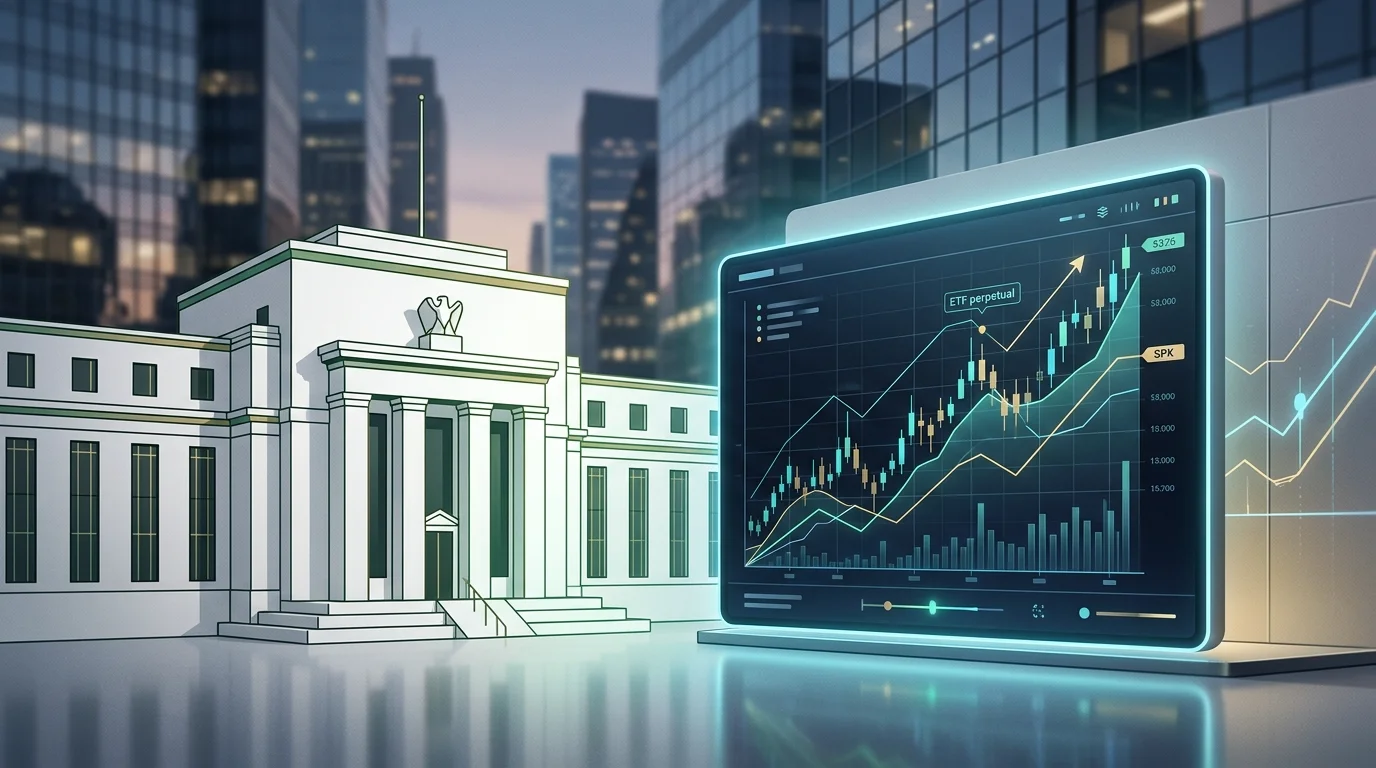
Platforms like Zoomex and decentralized derivative venues are expanding perpetual contracts pegged directly to benchmark index ETFs (such as SPY and QQQ). With the federal funds rate anchored at **3.63%** and the 10-year Treasury yield sitting near **5.01%**, capital efficiency has become the primary battleground for positioning ahead of Fed remarks.
---
The 24/7 Problem: Why Traditional Futures Fall Short
The fundamental limitation of traditional Wall Street equity markets is scheduling:
- **The Closing Bell Constraint:** New York cash markets close at 4:00 PM EST. If emergency geopolitical headlines or after-hours macroeconomic data hit overnight, spot ETF traders cannot adjust risk.
- **Expiration Rollover Friction:** Standard CME quarterly futures require contract rolling every 90 days. This creates contango or backwardation drag and recurring broker transaction commissions.
**ETF Perpetuals eliminate expiration dates entirely.** By using an automated 8-hour funding rate mechanism, perpetual contracts continuously track the spot net asset value (NAV) of the underlying ETF, enabling traders to maintain positions indefinitely with 24/7 execution liquidity.
---
Market Positioning Heading into the Fed Decision
The surge in ETF perpetual interest arrives at an extraordinary valuation junction:
- **The S&P 500 sits at 7,637.76**, maintaining bullish momentum despite tight monetary conditions.
- **The 10-Year Treasury Yield stands at 5.01%**, creating a persistent equity risk premium compression.
- **The Cboe Volatility Index (VIX) at 15.44** indicates that options markets are pricing in an unusually calm baseline, leaving equity markets vulnerable to sharp volatility expansion if Fed guidance leans hawkish.
For directional traders, ETF perpetuals offer high capital efficiency: rather than posting 100% cash or standard 50% Regulation-T margin on spot ETFs, traders can express high-conviction Fed bets with flexible leverage tiers.
---
The Structural Traps to Watch
Despite their continuous liquidity and capital efficiency, perpetual swaps on traditional equities carry structural hazards that can catch unhedged accounts off guard:
First is **funding rate drag**. When retail sentiment crowds heavily on the long side ahead of a rate cut announcement, the funding rate spikes. Holding a leveraged long position through multiple 8-hour funding intervals can rapidly erode principal—even if the index trades sideways.
Second is **NAV basis dislocation**. Unlike spot ETFs backed by physical stock baskets, perpetual contracts rely on continuous arbitrage. During extreme market events, such as surprise commentary during Jerome Powell's press conference, spreads between the perpetual mark price and the underlying cash index can widen abruptly.
Finally, **liquidation cascades** remain an ever-present risk. Because leverage tiers are automated, a 40-point flash dip in index futures can trigger cascading margin liquidations before a trader has time to deposit collateral.
---
Key Takeaway for Market Participants
The rise of ETF perpetuals on venues like Zoomex represents the inevitable convergence between crypto market architecture and traditional finance.
For institutional and active retail traders, these instruments offer powerful round-the-clock hedging capabilities ahead of central bank announcements. However, navigating them requires strict leverage discipline—because when the Fed speaks, high leverage turns minor basis dislocations into catastrophic drawdowns.
*Disclaimer: This analysis is for educational and news reporting purposes only and does not constitute financial, investment, or trading advice.*