AI Sell-Off Intensifies as Investors Ditch Chip Stocks
Executive Market Summary
A sharp global sell-off in semiconductor stocks intensified on July 28, 2026, as Nvidia circular-funding concerns and Asian memory-chip plunges...
The artificial intelligence hardware trade encountered its most aggressive valuation reset of 2026 on July 28, as global semiconductor stocks suffered steep double-digit declines across US, Asian, and European exchanges [Source: MarketWatch, CNBC, Leverage Shares]. Triggered by growing skepticism over massive capital expenditure payback timelines, circular AI funding structures, and emerging competitive pressures, investors aggressively unwound leveraged semiconductor positions [Source: MarketWatch, Leverage Shares]. The momentum unwind accelerated ahead of the Federal Reserve's two-day policy meeting, putting pressure on broader tech indices [Source: CNBC, IG UK].
Asian Memory Giants Catalyst and US Contagion
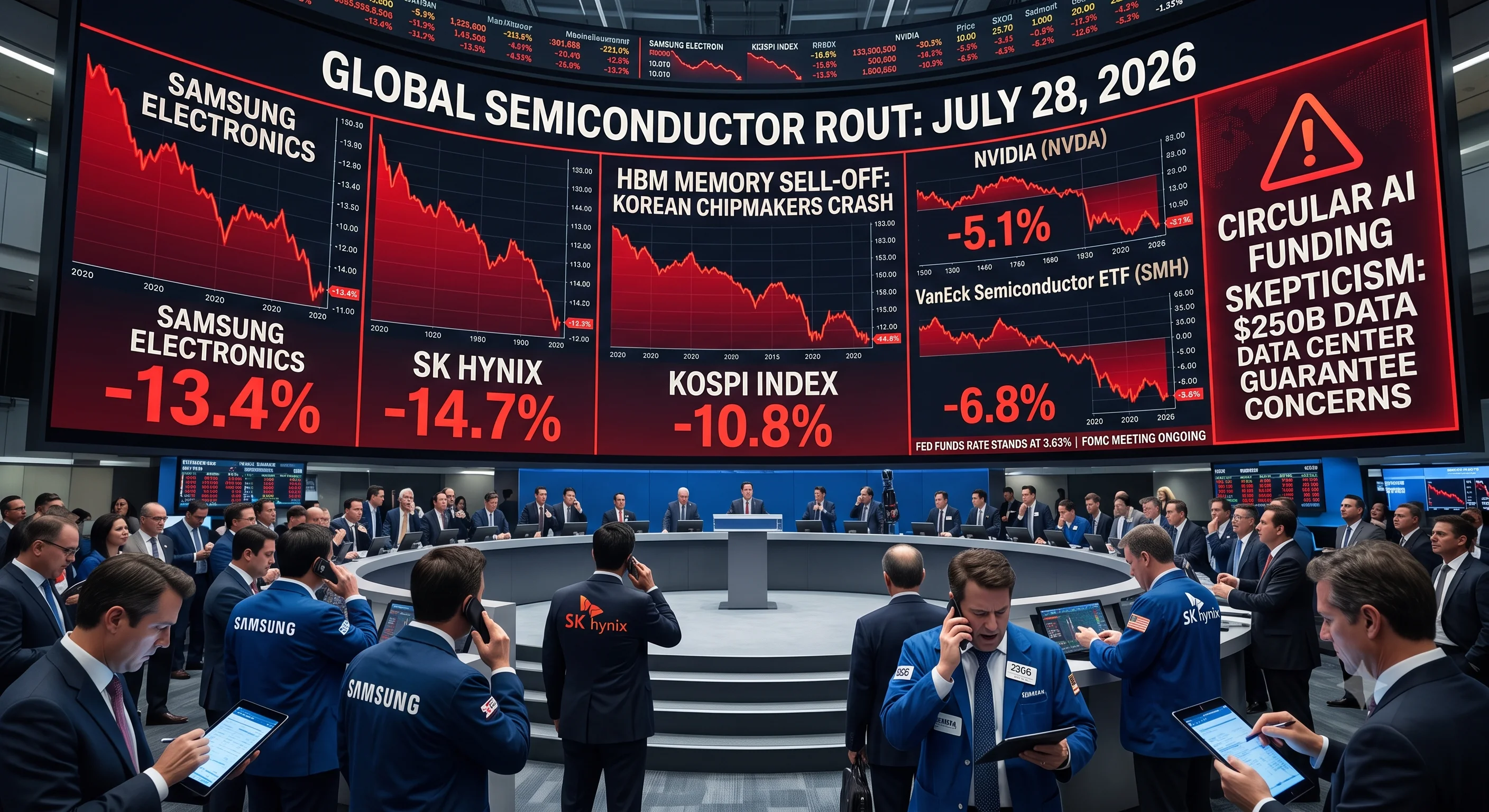
The sell-off reached a crescendo during July 28 Asian trading hours [Source: CNBC, Yahoo Finance]. South Korea's benchmark KOSPI Index crashed **10.8%** to close at 6,023.66, triggering circuit breakers and temporary trading halts [Source: Yahoo Finance, AP]. The decline was led by the world's primary High Bandwidth Memory (HBM) suppliers—**Samsung Electronics**, which plunged **13.4%**, and **SK Hynix**, which plummeted **14.7%** in a single session [Source: CNBC, Yahoo Finance].
The rout in Asia followed persistent weakness across Wall Street chipmakers [Source: CNBC, Vantage Markets]. Nvidia (NASDAQ: NVDA) dropped approximately **5%** as market participants raised questions over reported $250 billion financing arrangements tied to OpenAI data center projects, reigniting debates over circular capital flows [Source: MarketWatch, Vantage Markets]. Simultaneously, legacy memory and storage names like Micron (MU), SanDisk (SNDK), and Western Digital (WDC) extended multi-week drawdowns [Source: MarketWatch, Leverage Shares].
| Market / Asset | Single-Day / July Movement | Primary Market Driver |
|---|---|---|
| **Samsung Electronics** | **-13.4%** (July 28) | HBM demand sustainability re-assessment [Source: CNBC, Yahoo Finance]. |
| **SK Hynix** | **-14.7%** (July 28) | Sharp Asian chip-sector unwinding [Source: CNBC, AP]. |
| **KOSPI Index (South Korea)** | **-10.8%** (Close: 6,023.66) | Heavy concentration in memory chipmakers [Source: CNBC, Yahoo Finance]. |
| **Nvidia (NVDA)** | **~-5.0%** (Single-session drop) | Circular funding concerns & data center guarantees [Source: MarketWatch, Vantage Markets]. |
| **Federal Funds Rate** | **3.63%** (Current Target) | FOMC meeting underway (July 28–29) [Source: St. Louis Fed, CNBC]. |
Circular Funding Fears and Competitive Friction
Beyond valuation fatigue, two specific fundamental narrative shifts accelerated the liquidation across chip equities [Source: MarketWatch, Leverage Shares]:
- **Circular Financing Dynamics:** Analysts pointed to increasing friction surrounding hardware vendors guaranteeing debt or equity commitments for downstream AI labs, raising concerns that reported revenue growth may be partially fueled by vendor-backed balance sheets [Source: MarketWatch, Vantage Markets].
- **Lithography and Hardware Competition:** Selling pressure in European equipment leader ASML continued following reports of competitive mass-production milestones in immersion Deep Ultraviolet (DUV) lithography out of Chinese state-backed manufacturing initiatives [Source: MarketWatch, Leverage Shares].
FOMC Rate Stance and Sector Rotation
The chip-sector sell-off comes at a delicate macroeconomic junction [Source: CNBC, IG UK]. The Federal Open Market Committee (FOMC) convened on July 28, with the benchmark Federal Funds Effective Rate holding at **3.63%** [Source: Federal Reserve, CNBC]. While markets broadly anticipate a policy rate hold, elevated corporate borrowing costs mean that tech companies spending heavily on hardware infrastructure face higher hurdles to prove return on invested capital (ROIC) [Source: INSEAD Knowledge, CNBC].
Despite the severity of the drop, market strategists like Fundstrat's Tom Lee note that rotation out of semiconductor hardware has coincided with capital inflows into mega-cap software platforms, balance-sheet defensive names, and crypto assets, characterizing the drawdown as a necessary valuation reset within an ongoing secular AI cycle rather than a structural collapse [Source: MarketWatch, Leverage Shares].
**Disclaimer**: This article is for informational purposes only and does not constitute financial advice. Always conduct your own research (DYOR) before making investment decisions. Market data and prices are subject to change. Sources verified as of July 28, 2026.